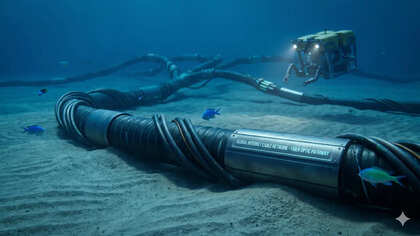
Most people think the internet comes from satellites, mobile towers or “the cloud.”
It does not.
Almost everything we do online — banking, WhatsApp calls, cloud computing, online business, government systems and AI services — travels through fibre-optic cables lying quietly on the ocean floor.
The modern digital economy literally runs underwater.
That is why recent reports connected to Iran’s Islamic Revolutionary Guard Corps (IRGC) discussing undersea internet cables in the Strait of Hormuz should concern governments across the Indo-Pacific region, including Small Island Developing States (SIDS) such as Papua New Guinea.
According to reporting by The Times of India, IRGC-linked discussions reportedly involve transforming the Strait of Hormuz into a form of “digital toll booth” by monetizing or exerting leverage over submarine internet cables passing through the region.
At first glance, this may appear to be a Middle Eastern geopolitical issue.
It is not.
It is really about the future of global digital infrastructure, international law and control over the arteries of the internet itself.
The World’s Digital Chokepoints
For decades, strategic maritime chokepoints were mainly discussed in relation to oil tankers and naval power.
Today, they are also digital chokepoints.
The Strait of Hormuz is not only an energy corridor. It is also a major data corridor carrying enormous volumes of international internet traffic between regions.
That changes the geopolitical equation completely.
Because whoever can threaten, influence or disrupt submarine cable routes potentially gains leverage over:
- global finance;
- cloud computing;
- AI systems;
- telecommunications;
- digital trade; and
- state communications.
This is why undersea cables are increasingly being viewed as strategic infrastructure alongside ports, pipelines and shipping lanes.
International Law Is Struggling To Keep Up
The problem is that international law was never designed for this level of digital dependency.
Most submarine cable protections still sit largely within the framework of the United Nations Convention on the Law of the Sea (UNCLOS).
But UNCLOS was drafted long before:
- cloud infrastructure;
- AI economies;
- cyber warfare;
- hyperscale data centres; and
- modern digital geopolitics.
Today, a damaged submarine cable can affect entire economies.
Banking systems can slow down.
Cloud services can fail.
Governments can lose connectivity.
Emergency communications can become unstable.
Yet the world still lacks a modern comprehensive legal regime specifically addressing:
- protection of critical digital submarine infrastructure;
- state responsibility for interference with international cable systems;
- hybrid warfare involving digital infrastructure;
- cyber-physical attacks on submarine systems; and
- legal obligations during cable repair operations in conflict zones.
This legal gap is becoming increasingly dangerous.
Why This Matters For The Indo-Pacific
The Indo-Pacific is rapidly becoming one of the world’s most strategically contested digital regions.
Countries are competing over:
- submarine cable routes;
- AI infrastructure;
- cloud ecosystems;
- satellite networks;
- digital trade corridors; and
- cyber governance influence.
The Pacific is no longer digitally isolated.
It is now becoming integrated into global digital infrastructure networks.
That creates opportunity.
But it also creates vulnerability.
Future geopolitical disputes may increasingly involve pressure points linked to digital infrastructure rather than traditional military confrontation alone.
Submarine cables are now part of strategic statecraft.
Why Papua New Guinea And Pacific SIDS Should Care
For Papua New Guinea and other Pacific SIDS, the risks are significant.
Many island states still operate with limited cable redundancy.
A single major cable disruption can isolate an entire country or severely degrade connectivity.
That affects:
- banking;
- aviation;
- government systems;
- education;
- health services;
- mobile communications; and
- economic activity.
As PNG continues expanding digital transformation initiatives and international connectivity projects, digital resilience becomes a national security issue — not merely a telecommunications issue.
Pacific states should therefore begin strengthening national frameworks dealing with:
- submarine cable protection;
- critical infrastructure security;
- cable landing station protection;
- cyber resilience;
- emergency redundancy planning;
- maritime-cyber coordination; and
- regional digital infrastructure cooperation.
The Future Of Cybersecurity Is Also Maritime
For years, cyber discussions focused mainly on hackers, malware and online platforms.
But the future of cyberspace security may increasingly involve physical infrastructure beneath the sea.
The internet is no longer just virtual.
It is geopolitical.
And much of it runs silently across the ocean floor.